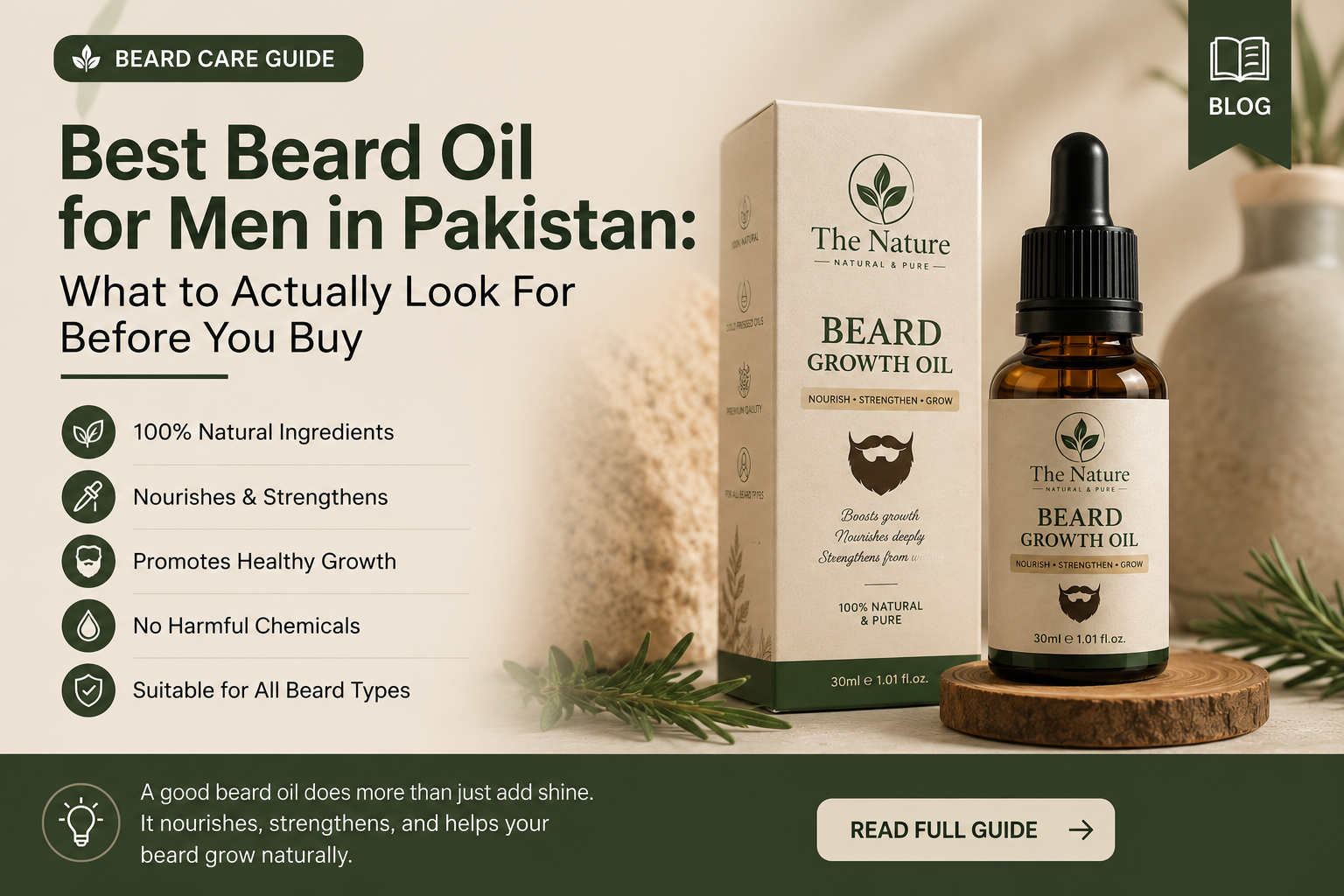
Search “best beard oil in Pakistan” and you’ll get a dozen lists, most of them ranking products by price or brand recognition rather than what’s actually in the bottle. That’s backwards. The right way to choose a beard oil is to understand what a handful of key ingredients actually do — then check whether a product has them in real, meaningful amounts, not buried at the bottom of an ingredient list behind cheap filler oil.
This guide covers what to look for, the specific problems beard oil can and can’t solve, and how to match a product to your actual beard — whether that’s early stubble, a patchy few-month beard, or a full beard you’re trying to thicken and soften.
What Beard Oil Actually Does (and Doesn’t)?
Before comparing products, it helps to be clear about what beard oil is realistically capable of:
What it can do well:
- Soften coarse, wiry beard hair so it’s less scratchy and easier to style
- Moisturise the skin underneath the beard, which is the actual cause of most beard itch
- Reduce flaking and irritation under the beard (often called “beardruff”)
- Add shine and make an existing beard look healthier and better groomed
- Support the conditions for healthier growth by improving scalp/skin circulation and reducing follicle-clogging buildup
What it can’t do:
- Beard oil cannot change your genetics. If your patchiness is genetically determined (which it usually is, tied to androgen receptor distribution in facial skin), no oil will make hair grow somewhere a follicle doesn’t exist or isn’t active.
- It’s not an instant fix — real changes in thickness or density take 8–12 weeks of consistent use at minimum, not days.
Any product or article that promises a full beard “guaranteed” in a couple of weeks is overselling it. The honest, useful role of a good beard oil is supporting healthier growth from the follicles you do have, while fixing the itch, dryness, and coarseness that make the growing-out phase uncomfortable.
The Ingredients Worth Looking For
Not all “natural” beard oils are equal — plenty are mostly a cheap base oil (often just mineral oil or a generic vegetable oil) with a nice scent added. Here’s what should actually be doing the work:
Castor Oil — The most well-established ingredient for beard growth support. Rich in ricinoleic acid, which has been linked to improved blood microcirculation to hair follicles. It’s also thick and heavy, which is why it’s usually blended with lighter oils rather than used alone.
Rosemary Essential Oil — The most scientifically discussed natural ingredient in this space. A 2015 clinical study (Panahi et al.) found topical rosemary oil performed comparably to 2% minoxidil for hair regrowth over six months, with less scalp itching reported. It’s thought to work partly by inhibiting DHT activity at the follicle and partly by improving circulation.
Jojoba Oil — Technically a liquid wax, not an oil, with a structure close to the skin’s natural sebum. This is what actually addresses beard itch and beardruff at the root — most beard itch isn’t from the hair itself, it’s from dry, under-moisturised skin underneath it.
Tea Tree Essential Oil — An antimicrobial and antifungal essential oil that helps keep the skin under the beard clean, which matters because buildup and bacterial/fungal imbalance under a beard is a common contributor to beardruff and ingrown hairs.
Argan Oil — A lightweight conditioning oil that smooths coarse beard hair and adds shine without leaving a greasy film — important because a common complaint with heavier, cheaper beard oils is that they look wet or oily rather than groomed.
Vitamin E — An antioxidant that helps protect follicles from oxidative stress, one of the underappreciated contributors to slowed or weakened hair growth over time.
If a beard oil you’re considering lists a generic “mineral oil” or “fragrance oil” as a primary ingredient rather than one of the above, it’s likely optimised for scent and shelf life rather than actual beard or skin benefit.
Matching Beard Oil to Your Actual Problem
Different beard concerns call for slightly different priorities:
If your main issue is beard itch and beardruff (common in the first few months of growing out a beard): prioritise a formula heavy in Jojoba and Tea Tree Oil — these address the dry, irritated skin underneath the beard, which is the actual source of the itch, not the beard hair itself.
If your main issue is patchiness or slow growth: look for Rosemary Essential Oil and Castor Oil as leading ingredients, since these are the two with the most circulation/follicle-stimulation evidence behind them.
If your main issue is coarse, wiry, unmanageable hair: Argan Oil and Sweet Almond Oil are the ones doing the conditioning and softening work.
If you have sensitive skin: Jojoba Oil is generally the gentlest, most hypoallergenic option in this list. Always patch test a new oil on a small area of skin 24 hours before full application, regardless of how “natural” the ingredients are — essential oils in particular can cause reactions in sensitive individuals.
Most well-formulated beard growth oils (including ours) combine several of these ingredients rather than relying on just one, since each addresses a different part of the problem — growth stimulation, skin health, and hair conditioning are three separate jobs.
How to Actually Use Beard Oil (Most Men Get This Wrong)?
A few drops massaged in the wrong way at the wrong time is why some people feel beard oil “doesn’t work”:
- Apply after washing your face or beard, when skin is slightly damp — not bone dry and not soaking wet.
- Use 2–3 drops for stubble, 3–5 for a medium beard, 5–8 for a longer, fuller beard. Start with less; it’s easy to add more.
- Massage into the skin beneath the beard first, in circular motions, for 2–3 minutes — this is where the itch relief and follicle stimulation actually happen, not just on the surface of the hair.
- Work the remainder through the length of the beard hair for conditioning and shine.
- Use once or twice daily, and be consistent — most visible results in beard softness and itch reduction show up within 1–2 weeks, while thickness and density changes take 4–8 weeks of regular use.
Our Beard Growth Oil
Our formula combines Castor Oil, Jojoba Oil, Argan Oil, Sweet Almond Oil, Rosemary Essential Oil, Tea Tree Essential Oil, Vitamin E, and Lavender Oil — covering growth support, skin health, and conditioning in one blend, without parabens, sulfates, mineral oil, or synthetic fragrance.
If beard itch specifically (rather than growth) is your main concern, our Jojoba Oil alone is also a good, gentler starting point, especially for sensitive skin.
Related reading: Castor Oil for Beard Growth — Does It Work on Patchy Spots? · Rosemary Oil vs Minoxidil: What the Research Actually Shows