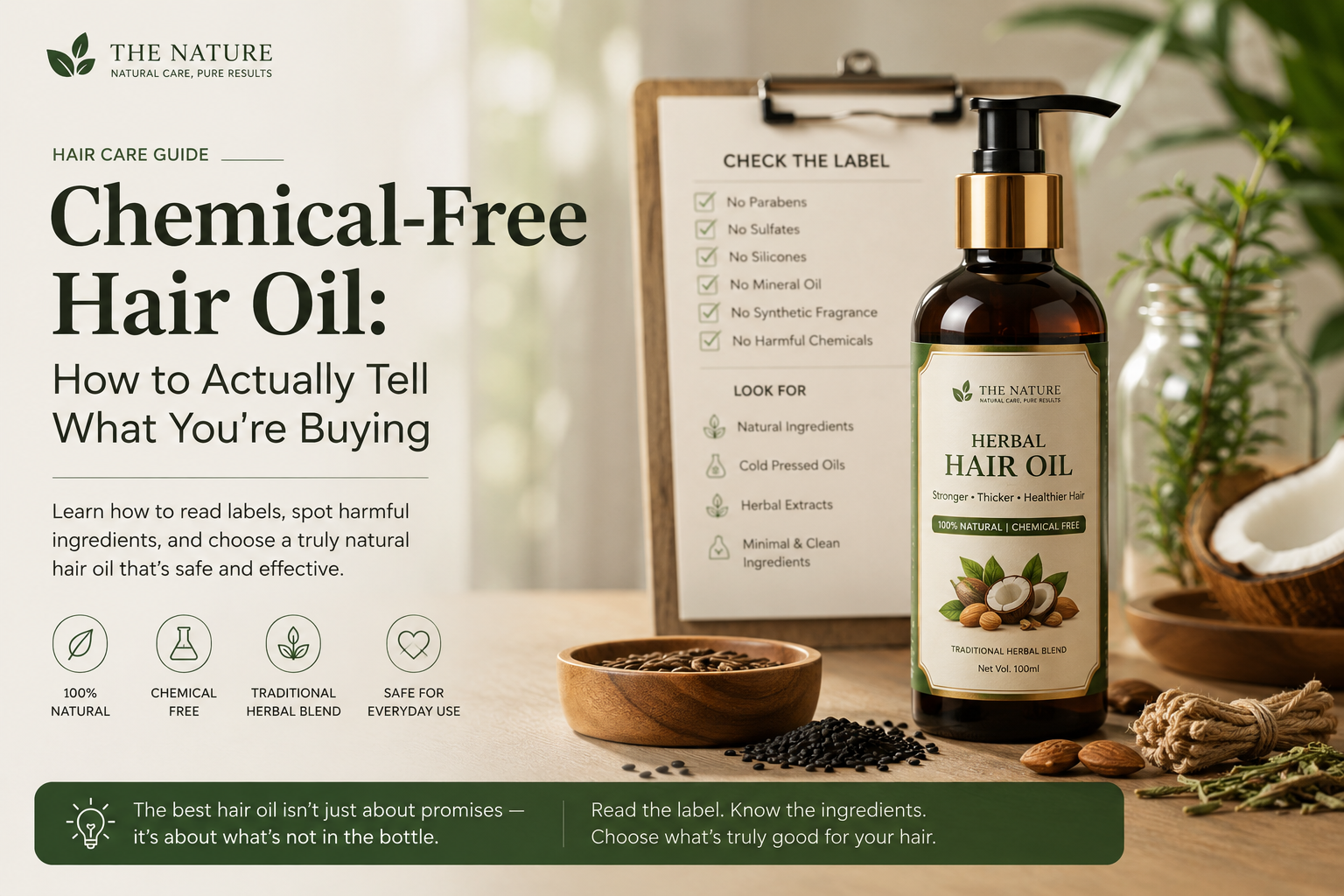
“Chemical-free,” “100% natural,” “pure” — these words appear on nearly every hair oil bottle on the shelf, including plenty that contain mineral oil, synthetic fragrance, and preservatives most people wouldn’t consider natural if they actually read the label. The words themselves aren’t regulated in any meaningful way, which means the only real way to know what you’re buying is to check the ingredient list yourself.
Here’s what that actually involves.
What “Chemical-Free” Should Actually Mean?
Strictly speaking, everything is made of chemicals — including water and the oil itself. What people usually mean by “chemical-free” is a product free from a specific set of additives commonly used to cut cost, extend shelf life, or improve texture and scent artificially:
Mineral oil — a petroleum byproduct used as a cheap filler in many “natural” oils. It sits on top of hair and skin rather than absorbing, and doesn’t offer the nutrient content of plant-derived oils. If an oil labelled “natural” lists mineral oil, paraffinum liquidum, or petrolatum, that’s worth noticing.
Parabens — preservatives (usually listed as methylparaben, propylparaben, etc.) used to extend shelf life. Common in mass-market formulations, generally avoided in genuinely natural products.
Sulfates — more relevant to shampoos than oils, but sometimes present in “2-in-1” hair oil products that also claim cleansing properties.
Synthetic fragrance — listed simply as “fragrance” or “parfum” without specifying the actual compounds. A genuinely natural oil’s scent comes from the oils themselves or from named essential oils, not an unlisted fragrance blend.
Silicones — ingredients like dimethicone that coat hair for an immediate smoothing effect but build up over time and don’t offer the same long-term conditioning as natural oils.
How to Actually Check a Label?
- Read the full ingredient list, not just the front of the bottle. Marketing copy on the front can say “natural” while the ingredient list on the back tells a different story.
- Look for INCI names you recognize — e.g. Ricinus Communis Seed Oil is castor oil, Simmondsia Chinensis Seed Oil is jojoba oil. A short, readable ingredient list of recognizable plant-derived oils is a good sign.
- Be wary of “fragrance” or “parfum” with nothing else specified — a genuinely natural product will typically name the essential oil responsible for scent instead.
- Check where the product is meant to be used — carrier oils (almond, jojoba, argan, castor, coconut, olive, mustard) are usually applied directly. Essential oils (rosemary, lavender, tea tree, neem) are highly concentrated and should always be diluted before use — if a product doesn’t mention dilution and it’s a pure essential oil, that’s a red flag in the instructions, not the ingredient itself.
A Quick Comparison: What’s In Ours
Since this is exactly what we’d want you to check on any product, here’s a straightforward look at what’s actually in our own range:
| Product | Type | Key Ingredient(s) | Free From |
|---|---|---|---|
| Almond Oil | Carrier oil | Cold-pressed sweet almond oil | Parabens, sulfates, mineral oil, synthetic fragrance |
| Amla Oil | Carrier oil | Indian gooseberry extract in oil base | Same as above |
| Argan Oil | Carrier oil | Cold-pressed Moroccan argan oil | Same as above |
| Castor Oil | Carrier oil | Cold-pressed castor seed oil | Same as above |
| Coconut Oil | Carrier oil | Virgin, unrefined coconut oil | Same as above |
| Jojoba Oil | Carrier oil | Cold-pressed jojoba (liquid wax) | Same as above |
| Mustard Oil | Carrier oil | Cold-pressed mustard seed oil | Same as above |
| Olive Oil | Carrier oil | Extra virgin olive oil | Same as above |
| Lavender Essential Oil | Essential oil (dilute before use) | Steam-distilled lavender | Same as above |
| Neem Essential Oil | Essential oil (dilute before use) | Cold-pressed/steam-distilled neem | Same as above |
| Rosemary Essential Oil | Essential oil (dilute before use) | Steam-distilled rosemary | Same as above |
| Tea Tree Essential Oil | Essential oil (dilute before use) | Steam-distilled tea tree | Same as above |
| Beard Growth Oil | Formulated blend | Castor, jojoba, argan, almond, rosemary, tea tree, Vitamin E, lavender | Same as above |
A Word of Caution: “Natural” Doesn’t Automatically Mean “Safe for Everyone”
It’s worth separating two different ideas that sometimes get conflated: chemical-free (free from synthetic additives and fillers) and hypoallergenic (unlikely to cause a reaction). A completely natural, chemical-free essential oil can still cause irritation or an allergic reaction in some people, particularly if used undiluted or by someone with sensitive skin. Always patch test any new oil, chemical-free or not, on a small area of skin 24 hours before full application — and if you have a known nut allergy, note that almond and argan oils are derived from tree nuts.
Browse our full natural oils range →
Related reading: Which Hair Oil Do You Actually Need? A Scalp-Type Guide · Almond Oil vs Argan Oil vs Jojoba Oil: Which Is Right for You?