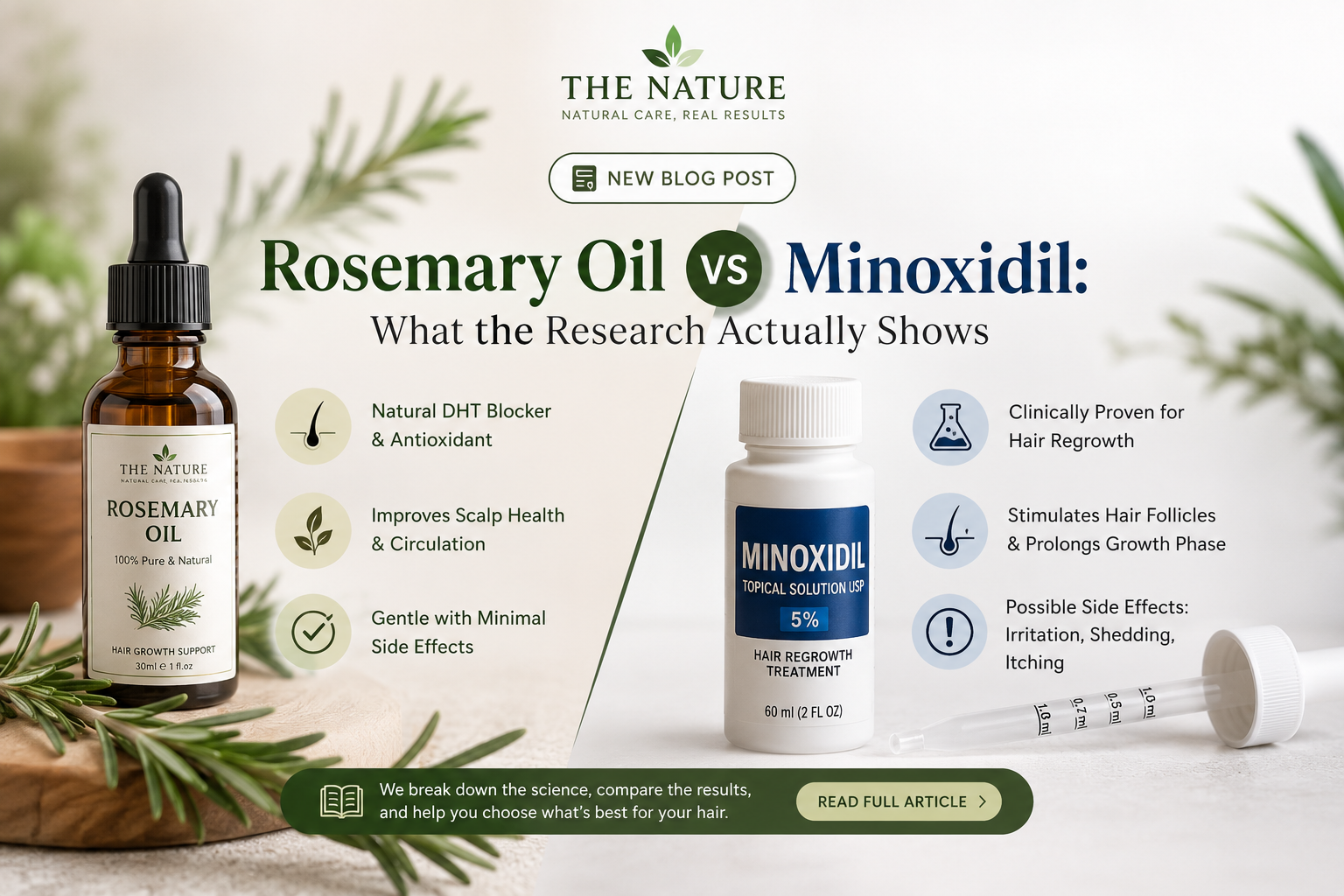
If you’ve spent any time researching natural hair loss remedies, you’ve probably seen the claim: “rosemary oil works just as well as minoxidil.” It’s repeated across hundreds of articles and social media posts, almost always citing the same single study. The claim isn’t fabricated, but it’s also not the whole story, and most of what circulates online strips out the context that actually matters for deciding what’s right for you.
Here’s the honest version, including the parts that don’t make for as exciting a headline.
The Study Everyone’s Referencing
In 2015, a research team led by Panahi published a randomized comparative trial in the journal SKINmed. It enrolled 100 people with androgenetic alopecia (the genetic, hormone-driven pattern hair loss most people mean when they say “male pattern baldness” or its female equivalent). Half the group applied pure rosemary essential oil to the scalp twice daily; the other half used 2% minoxidil. After six months, both groups showed a significant increase in hair count, with no statistically significant difference between them, and the rosemary group reported notably less scalp itching than the minoxidil group.
That’s a real, peer-reviewed finding. But three details usually get left out when this study gets summarized into a shareable headline:
It compared rosemary to 2% minoxidil, not 5%. The 5% formulation is what’s more commonly used and recommended for men today, and it’s generally considered more effective than the 2% version. The study never tested rosemary against the stronger, more typical minoxidil dose.
It didn’t have a placebo group. Without a placebo arm, it’s harder to rule out how much of the improvement in both groups came from something other than the treatments themselves, consistent scalp massage, general awareness of hair health during the study period, or natural fluctuation in hair growth cycles.
The actual difference in hair count was small. Independent reviewers looking at the raw numbers have pointed out that the average increase was modest in both groups, with a fairly wide spread between individual participants. This was a real effect, but not a dramatic one, in either arm of the study.
What’s Happened Since 2015?
The original study isn’t the only data point anymore. A few more recent studies are worth knowing about:
- A 2022 animal study on hairless mice found a rosemary-based lotion outperformed a minoxidil-treated control group, though animal studies don’t always translate directly to human results.
- A 2022 human study reported rosemary oil producing comparable effects to minoxidil after six weeks, a shorter timeframe than the original 2015 trial.
- A 2023 review paper covering natural alternatives for pattern hair loss gave rosemary oil particular attention as one of the more promising options in that category, while still calling for larger, better-controlled trials.
- More recent placebo-controlled trials combining rosemary with other ingredients (such as castor oil or lavender oil) have shown measurable improvements in hair growth rate, thickness, and density compared to a coconut oil control, suggesting rosemary may work better as part of a blend than used entirely alone.
The pattern across this research is consistent: rosemary oil has a real, measurable effect on hair growth markers. It’s not nothing. But it also isn’t the slam-dunk “beats pharmaceutical treatment” story that gets repeated online, it’s a genuinely promising natural option with a smaller and less rigorously tested evidence base than minoxidil, which has decades of large-scale clinical trials behind it.
How Rosemary Oil Is Thought to Work?
Rosemary contains carnosic acid and several other active compounds believed to support hair growth through a few mechanisms:
- Improved circulation, rosemary’s compounds appear to widen blood vessels in the scalp (a vasodilation effect), improving the supply of oxygen and nutrients to hair follicles.
- DHT inhibition, some research suggests rosemary has mild anti-androgenic properties, meaning it may partially block DHT, the hormone most responsible for the follicle shrinkage seen in pattern hair loss.
- Antioxidant protection, rosemary’s antioxidant compounds may help protect follicles from oxidative stress, one of the less-discussed contributors to slowed or weakened hair growth over time.
Minoxidil works differently, it’s a vasodilator that’s believed to prolong the growth (anagen) phase of the hair cycle, and its effectiveness is backed by a much larger and longer-running body of clinical research than any natural alternative currently has.
So Which One Should You Actually Use?
This depends on where you’re starting from:
If you have early-stage or mild pattern hair loss and want to try a gentler, more natural approach first, rosemary oil is a reasonable starting point with a real (if smaller) evidence base and a notably better side effect profile, the main risk is mild irritation or, rarely, a contact allergy in sensitive individuals.
If you have more advanced hair loss, or you’ve tried natural options without seeing results, minoxidil has a substantially larger and longer clinical track record, including at the 5% strength most commonly used today. It’s worth discussing with a dermatologist rather than starting cold.
If you’re already using minoxidil, there’s no known negative interaction with also using rosemary oil, some people use both together as part of a combined routine, since they work through different mechanisms. If you’re doing this, it’s still worth mentioning to a dermatologist, especially if you have a sensitive scalp.
Either way, patience matters more than the choice itself. Six months is close to the minimum timeframe used in the actual research to judge results, expecting a visible difference within a few weeks, with either option, is setting yourself up for disappointment.
Getting the Most from Rosemary Oil, If You Try It
- Use consistently, twice daily, for at least 3–6 months before judging results, this matches the timeframes used in the actual research.
- Always dilute rosemary essential oil in a carrier oil (roughly 1 part rosemary to 10 parts carrier oil) before applying to the scalp, using it undiluted increases the risk of irritation.
- Consider pairing it with Castor Oil, which showed strong results in combination with rosemary in more recent placebo-controlled research.
- Massage into the scalp for a few minutes during application, the massage itself may contribute to the circulation benefits, independent of the oil.
If you’d rather use a pre-blended formula rather than diluting essential oil yourself, our Rosemary Hair Growth Oil combines rosemary with castor oil and other supporting ingredients in a ready-to-use blend.
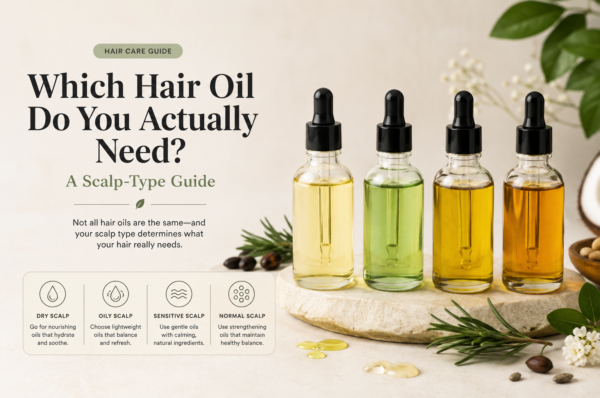
Related reading: How to Use Rosemary Oil for Hair Growth: Step-by-Step · Which Hair Oil Do You Actually Need? A Scalp-Type Guide
Shop the products in this guide: our Signature Hair Growth Oil
Browse the range: pure essential oils