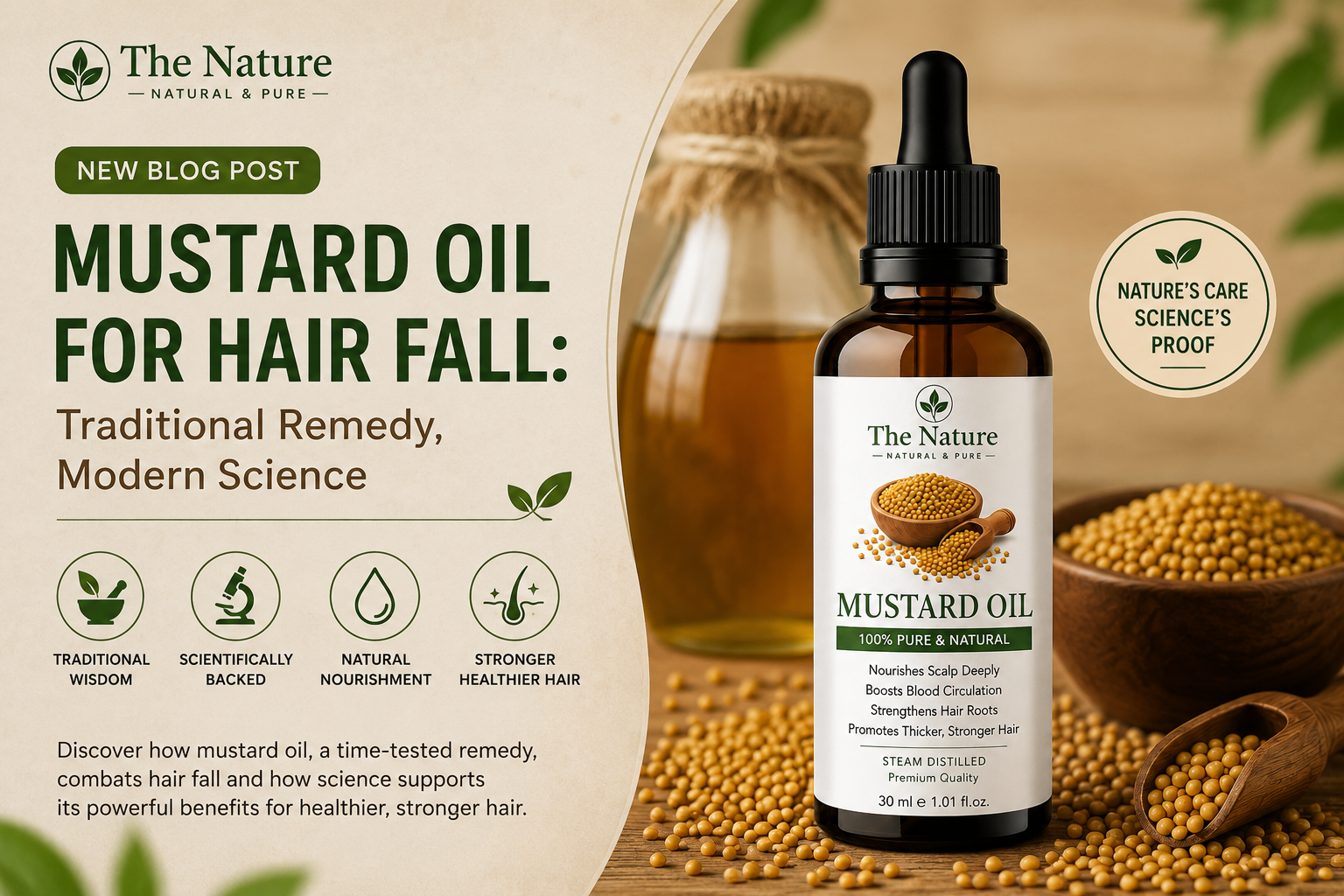
Mustard oil holds a specific place in South Asian households as a go-to remedy for hair fall, passed down through generations well before “natural hair care” became a broader trend. It’s worth looking at both the traditional reasoning behind it and what a more modern understanding of its properties adds to that picture.
Why Mustard Oil Has Been Used for Generations?
Mustard oil has a distinctive warming effect on the skin when applied — noticeably more so than most other carrier oils. This warming sensation is tied to increased blood circulation at the site of application, which is the primary reasoning behind its traditional use for hair fall and scalp health: better circulation to the scalp is believed to support healthier follicle activity and nutrient delivery.
What Mustard Oil May Actually Do?
Boosts scalp circulation — the warming effect isn’t just a sensation; it does correspond to genuinely increased blood flow to the area, which may support follicle health.
Rich in fatty acids — mustard oil contains a good concentration of monounsaturated and polyunsaturated fatty acids, which can help condition and strengthen hair strands, reducing breakage-related hair fall.
Antimicrobial properties — mustard oil has some natural antibacterial and antifungal qualities, which may help with certain scalp conditions that contribute to hair fall, such as mild fungal or bacterial imbalances.
A Word on Realistic Expectations
Most of the specific research on mustard oil and hair fall is limited compared to more heavily studied ingredients like rosemary oil or minoxidil. Its traditional use is well-established and its general properties (circulation, fatty acid content, antimicrobial action) are plausible mechanisms — but it’s fair to say the evidence here leans more on generations of traditional use than on large clinical trials, which is worth knowing if you’re comparing it directly against something like rosemary oil, where more specific clinical research exists.
Dealing With Mustard Oil’s Strong Smell
This is the most common complaint, and it’s completely normal — not a sign of poor quality or spoilage. A few ways to manage it:
- Blend a few drops of rosemary or lavender essential oil into the mustard oil before application.
- Use it as an overnight treatment and wash thoroughly in the morning rather than leaving it in during the day.
- A thorough double-shampoo after rinsing helps remove lingering scent more effectively than a single wash.
Using Mustard Oil Safely, Especially on Sensitive Scalps
Mustard oil’s warming effect, while normal, can be intense for some people — particularly those with sensitive skin. A few guidelines:
- Patch test first — apply a small amount to the inner forearm and wait 24 hours before using on the scalp, especially if you’ve never used mustard oil before.
- Dilute for sensitive scalps — mixing mustard oil with a milder oil like coconut or almond oil (roughly 1:1) reduces the intensity of the warming sensation while retaining some of the benefits.
- Mild warmth is expected; burning is not — a gentle warming sensation is normal, but if you experience actual burning, redness, or significant irritation, rinse off immediately and avoid future use.
- Avoid if you have a known mustard allergy — even topical use can trigger a reaction in people with a mustard or crucifer family allergy, regardless of ingestion.
How to Use Mustard Oil for Hair Fall?
- Warm a small amount slightly (not hot) and massage into the scalp using fingertips.
- Focus on areas experiencing the most hair fall, massaging in circular motions for 3–5 minutes to maximise the circulation benefit.
- Leave in for at least 30–60 minutes, or as an overnight treatment for deeper effect.
- Wash thoroughly, likely twice, to fully remove the oil and its scent.
- Use 2–3 times per week for consistency.
Related reading: Which Hair Oil Do You Actually Need? A Scalp-Type Guide