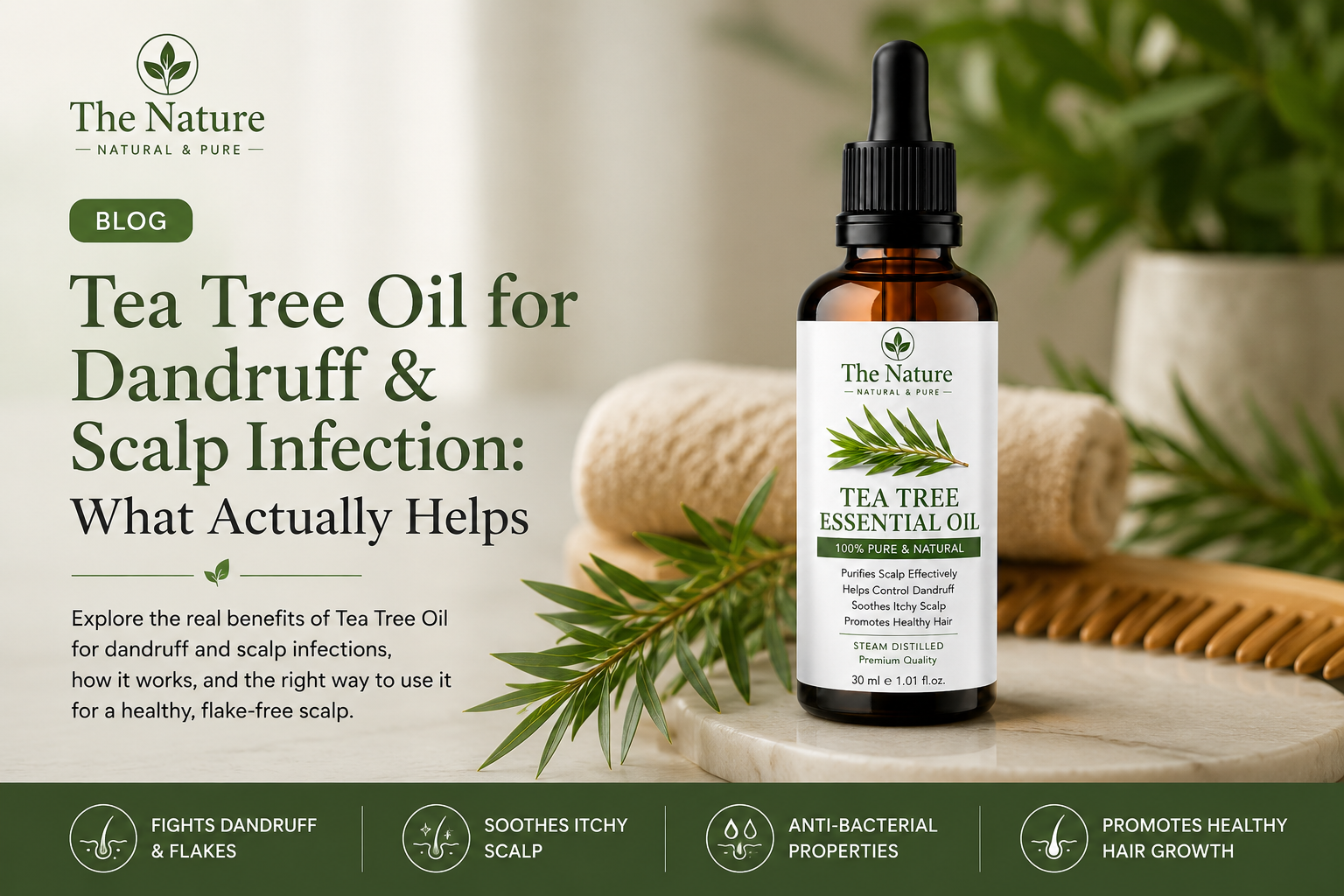
Dandruff is one of the most common scalp complaints, and tea tree oil is one of the most frequently recommended natural remedies for it — with genuine reasoning behind the recommendation, not just tradition. Here’s what’s actually happening with dandruff, why tea tree oil specifically targets it, and where its limits are.
What Actually Causes Dandruff?
Most dandruff isn’t simply “dry scalp” — it’s caused by an overgrowth of a yeast-like fungus called Malassezia, which lives naturally on everyone’s scalp in small amounts but can overgrow and trigger irritation, increased skin cell turnover, and the visible flaking associated with dandruff. This is an important distinction, because it explains why purely moisturising treatments sometimes don’t fully resolve dandruff — they address dryness, not the underlying fungal factor.
How Tea Tree Oil Targets This Specifically?
Tea tree oil has well-documented antifungal and antimicrobial properties, which is exactly why it’s positioned differently from a purely moisturising oil like coconut or almond oil. Rather than just soothing dryness, it directly targets the Malassezia overgrowth that’s driving the flaking and irritation in the first place.
This is also why tea tree oil is often compared to medicated anti-dandruff shampoos, which typically work through similar antifungal mechanisms (often using ingredients like ketoconazole or zinc pyrithione) — tea tree oil offers a gentler, natural alternative without the potentially harsher sulfates and chemicals found in many medicated formulas.
Tea Tree Oil for Scalp Infections
Beyond standard dandruff, tea tree oil’s antimicrobial properties are also used for more specific concerns like scalp folliculitis (inflamed, sometimes infected hair follicles) and general buildup-related irritation. For persistent or severe folliculitis, or any scalp condition involving significant pain, spreading redness, or pus, seeing a dermatologist is the right next step — tea tree oil is suited to mild-to-moderate cases, not a substitute for medical treatment of a genuine infection.
Always Dilute Before Use
Tea tree essential oil is highly concentrated and should never be applied directly to the scalp undiluted. Standard dilution: 3–5 drops of tea tree oil per 1–2 tablespoons of a carrier oil.
How to Use Tea Tree Oil for Dandruff?
- Dilute in a carrier oil at the ratio above (jojoba oil is a good pairing, since it also helps balance oily scalps that often accompany dandruff).
- Massage into the scalp, focusing on areas with visible flaking.
- Leave in for 20–30 minutes before washing, or as a more intensive overnight treatment for persistent cases.
- Use 2–3 times per week as a treatment, or add 5–6 drops to your regular shampoo bottle for ongoing daily maintenance between dedicated treatments.
Tea Tree Oil for Oily, Dandruff-Prone Scalps
Since oily scalps can be more prone to the buildup that contributes to dandruff, tea tree oil pairs particularly well with jojoba oil as a carrier — jojoba helps balance oil production while tea tree addresses the fungal factor, covering both contributing causes at once.
A Realistic Timeline
Improvement in flaking and irritation is often noticeable within 1–2 weeks of consistent use, faster than most hair-growth-focused treatments, since dandruff is a more surface-level, quicker-responding condition than deeper follicle activity.
For an alternative antifungal option, our Neem Essential Oil works through similar antimicrobial properties and can be used as a complementary or alternating treatment.
Related reading: Jojoba Oil for Oily Scalp: Why It Works · Which Hair Oil Do You Actually Need? A Scalp-Type Guide