
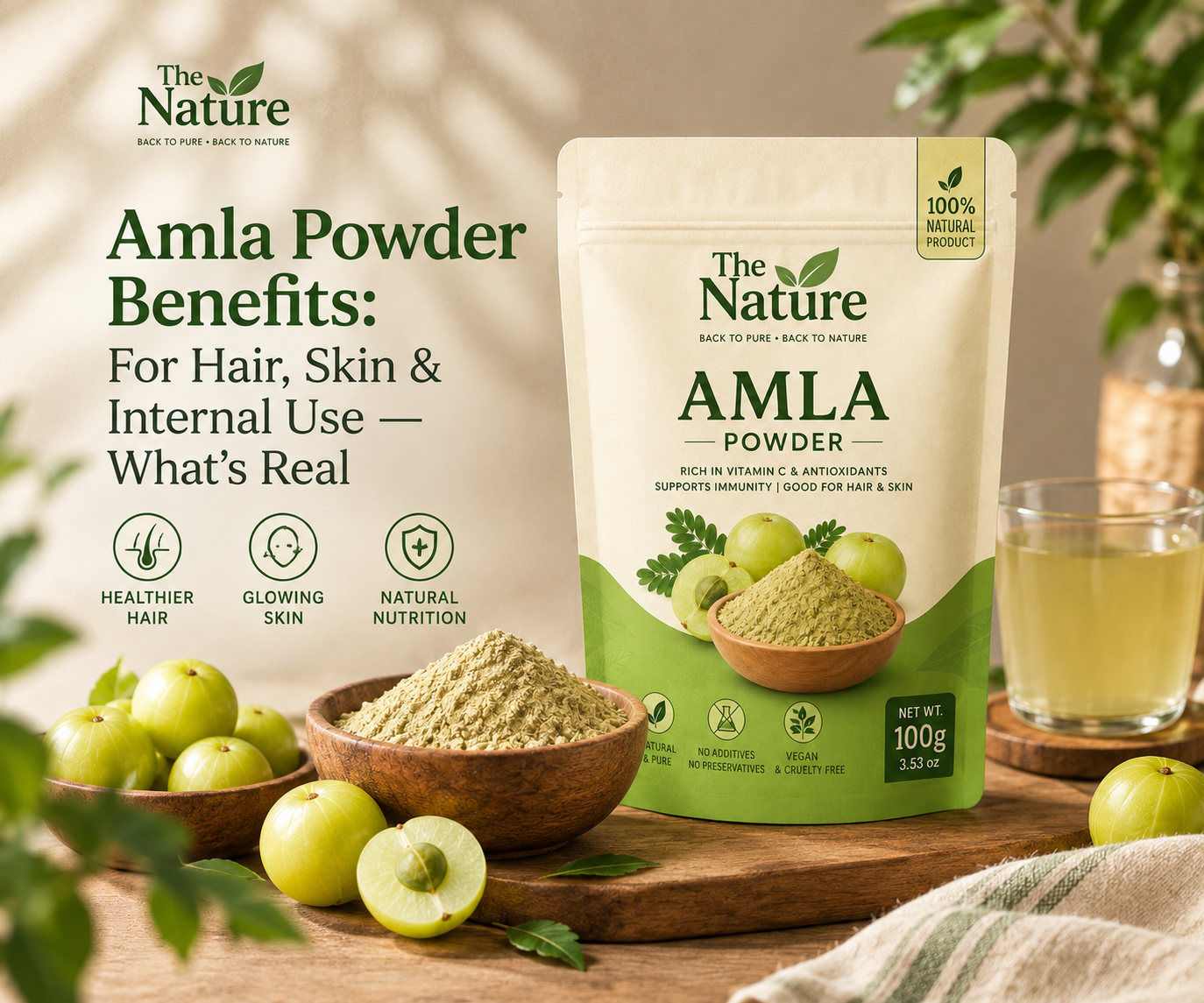
Amla Powder Benefits: For Hair, Skin & Internal Use — What’s Real
Amla (Indian Gooseberry) shows up in two different forms across natural hair and wellness products: oil and powder. They’re not interchangeable — each is suited to different uses. If you already know the research behind amla oil for premature greying, this covers where the powder form fits in, particularly its internal-use and skin applications that the oil isn’t used for.
Amla Powder vs Amla Oil: What’s the Actual Difference?
Amla oil is extracted and infused into a carrier oil base, used topically on hair and scalp — its main use case is hair and scalp treatment.
Amla powder is dried, ground whole amla fruit, which retains its fibre content and can be used three ways the oil isn’t suited for: mixed into hair masks with other ingredients, used as a skin-brightening face pack, and consumed internally mixed into water.
If your primary interest is scalp oil treatment specifically, the oil form is more practical. If you want a versatile ingredient for hair masks, skin, and internal use, the powder is the more flexible option.
Amla’s Vitamin C Content: What’s Actually Notable About It
Amla is genuinely one of the more concentrated natural sources of Vitamin C among commonly used fruits, along with a range of other antioxidant compounds. This matters for a few specific reasons:
- Collagen production — Vitamin C is a required cofactor for collagen synthesis, relevant both for skin structure and for hair follicle health, since follicles rely on collagen-containing structures.
- Antioxidant protection — supports protection of cells (including melanocytes, the pigment-producing cells in hair follicles) from oxidative stress.
- Immune support — Vitamin C’s general role in immune function applies when amla is consumed internally, not just used topically.
Using Amla Powder as a Hair Mask
This is a more versatile approach than amla oil alone, since powder allows combining with other ingredients:
Basic amla hair mask: Mix 2 tablespoons of amla powder with 1 tablespoon of yogurt and 1 tablespoon of honey into a smooth paste. Apply to scalp and hair, leave for 30 minutes, then rinse with warm water. Use twice weekly.
This combination adds yogurt’s mild lactic acid (gently exfoliating for the scalp) and honey’s humectant, moisturising properties alongside amla’s Vitamin C and antioxidant content — a more complete treatment than amla alone.
Using Amla Powder for Skin
Brightening face pack: Mix 1 tablespoon of amla powder with rosewater or plain water into a paste. Apply to the face, leave for 15–20 minutes, then rinse. Amla’s Vitamin C content is associated with supporting a brighter, more even-looking skin tone with regular use, though results vary and this works best as part of a broader skincare routine rather than a standalone solution for specific skin concerns.
Always patch test first — apply a small amount to the inner forearm and wait 24 hours before facial use, particularly if you have sensitive skin.
Taking Amla Powder Internally
Amla powder can be consumed by mixing 1 teaspoon into a glass of warm water, traditionally taken on an empty stomach in the morning. This is a traditional Ayurvedic practice associated with supporting digestion and general immunity, tied to the Vitamin C and antioxidant content discussed above.
A genuine caution here: if you’re on any regular medication, or have an existing health condition, consult your doctor before making amla powder a daily internal supplement — this applies more to internal consumption than topical hair or skin use, since anything taken internally has more potential to interact with medications or existing conditions.
Does Amla Powder Help With Grey Hair, Like the Oil Does?
The same honest framing applies here as with amla oil: amla’s antioxidant content may help slow the rate of new greying with consistent long-term use by supporting melanocyte health, but it will not reverse hair that has already turned grey. See our full breakdown in Amla Oil for Premature Greying for the complete picture on this specific topic — the underlying mechanism is the same whether you’re using the oil or the powder form.
Choosing Between Amla Powder and Amla Oil
- Choose the powder if you want a versatile, multi-purpose ingredient for hair masks, skin treatments, and internal use.
- Choose the oil if scalp treatment specifically is your main goal and you want something ready to apply without mixing.
- Some people use both — the oil as a regular scalp treatment, and the powder occasionally as a deeper hair mask or face pack.
Shop Organic Amla Powder → · Shop Amla Oil →
Related reading: Amla Oil for Premature Greying: Does It Actually Work? · Which Hair Oil Do You Actually Need? A Scalp-Type Guide