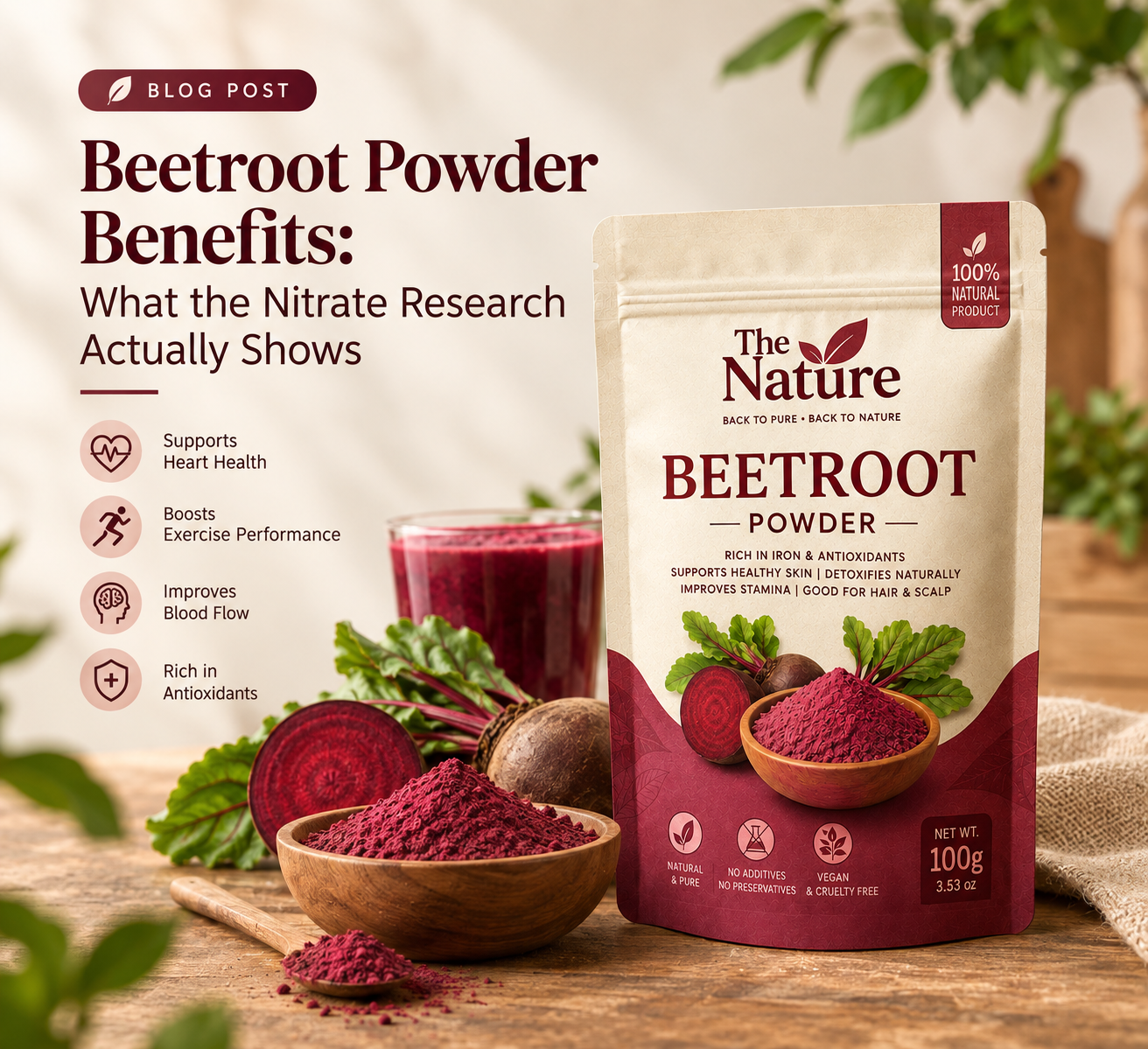
Beetroot Powder Benefits: What the Nitrate Research Actually Shows
Beetroot powder gets recommended for everything from skin brightening to athletic performance, but its most genuinely well-researched benefit is also its least talked about: dietary nitrates and what they do inside your body. Here’s the actual mechanism, what clinical research supports, and how to use it if blood pressure or exercise performance is your goal — separate from its more familiar kitchen and skincare uses.
How Beetroot’s Nitrates Actually Work?
Beetroot is naturally rich in dietary nitrates. Once consumed, these nitrates follow a specific pathway through the body: they’re absorbed in the small intestine, circulated to the salivary glands, converted to nitrite by oral bacteria, swallowed back into the stomach, and further converted into nitric oxide — a molecule that acts as a potent vasodilator, signalling blood vessels to relax and widen.
This is the mechanism behind beetroot’s two most studied benefits: supporting healthy blood pressure and improving exercise performance, particularly endurance activities.
What the Research Shows on Blood Pressure?
Multiple double-blind, placebo-controlled clinical trials have looked at beetroot juice or powder’s effect on blood pressure. The consistent finding: measurable reductions in systolic blood pressure, typically in the range of 3–5 mmHg in healthy adults, with effects appearing more pronounced in people with higher baseline blood pressure.
It’s important to be precise about what this means: a 3–5 mmHg reduction is real and measurable in a clinical setting, but it’s a modest effect — not a replacement for prescribed blood pressure medication or medical management of hypertension. If you have diagnosed high blood pressure, beetroot powder may be a reasonable dietary addition to discuss with your doctor, not a substitute for treatment.
What the Research Shows on Exercise Performance?
This is where beetroot’s reputation in fitness circles comes from. Several studies have examined nitrate-rich beetroot’s effect on endurance exercise, with research showing improved muscle oxygenation, blood flow, and, in some studies, measurable gains in submaximal exercise performance — plausibly because nitric oxide’s vasodilation effect improves oxygen delivery to working muscles.
It’s worth noting the research isn’t uniformly positive — some studies, particularly on short, explosive strength movements rather than endurance activity, have found no significant performance benefit. The clearest, most consistent evidence is specifically for endurance-based exercise (cycling, running) rather than strength or power-based activity.
Timing Matters More Than You’d Think
Based on the studied protocols, nitrate conversion to nitric oxide peaks roughly 2–3 hours after ingestion. This means:
- For exercise performance: consuming beetroot powder 2–3 hours before activity is the most studied and supported timing protocol — taking it immediately before a workout misses this window.
- For general blood pressure support: consistent daily intake appears to matter more than precise timing relative to any single event.
How to Use Beetroot Powder for This Purpose?
- Mix 1–2 teaspoons of beetroot powder into water, juice, or a smoothie.
- For exercise performance specifically, consume it 2–3 hours before your planned activity.
- For general cardiovascular support, daily consistent intake (rather than occasional large doses) reflects the protocols used in most supporting research.
A Practical Note
Daily beetroot powder intake has been used in clinical trials without reported safety concerns in healthy adults, but if you’re on blood pressure medication or have any cardiovascular condition, it’s worth mentioning to your doctor before adding it as a regular daily supplement, since combining a nitrate source with blood-pressure-lowering medication could have an additive effect worth being aware of.
Beyond Nitrates: Beetroot’s Other Uses
Beetroot powder’s culinary and skincare uses are separate from this nitrate-and-blood-pressure angle. If you’re also interested in it as a natural food colourant, a DIY face mask ingredient, or a natural lip tint, our full product page covers those uses in detail.
Shop Organic Beetroot Powder →
Related reading: Which Hair Oil Do You Actually Need? A Scalp-Type Guide